50 Fun Pictionary Words for Game Night (Categorized by Difficulty)
Plan a family or friends' game night with fun Pictionary prompts. Explore easy, medium, and challenging words for every group.
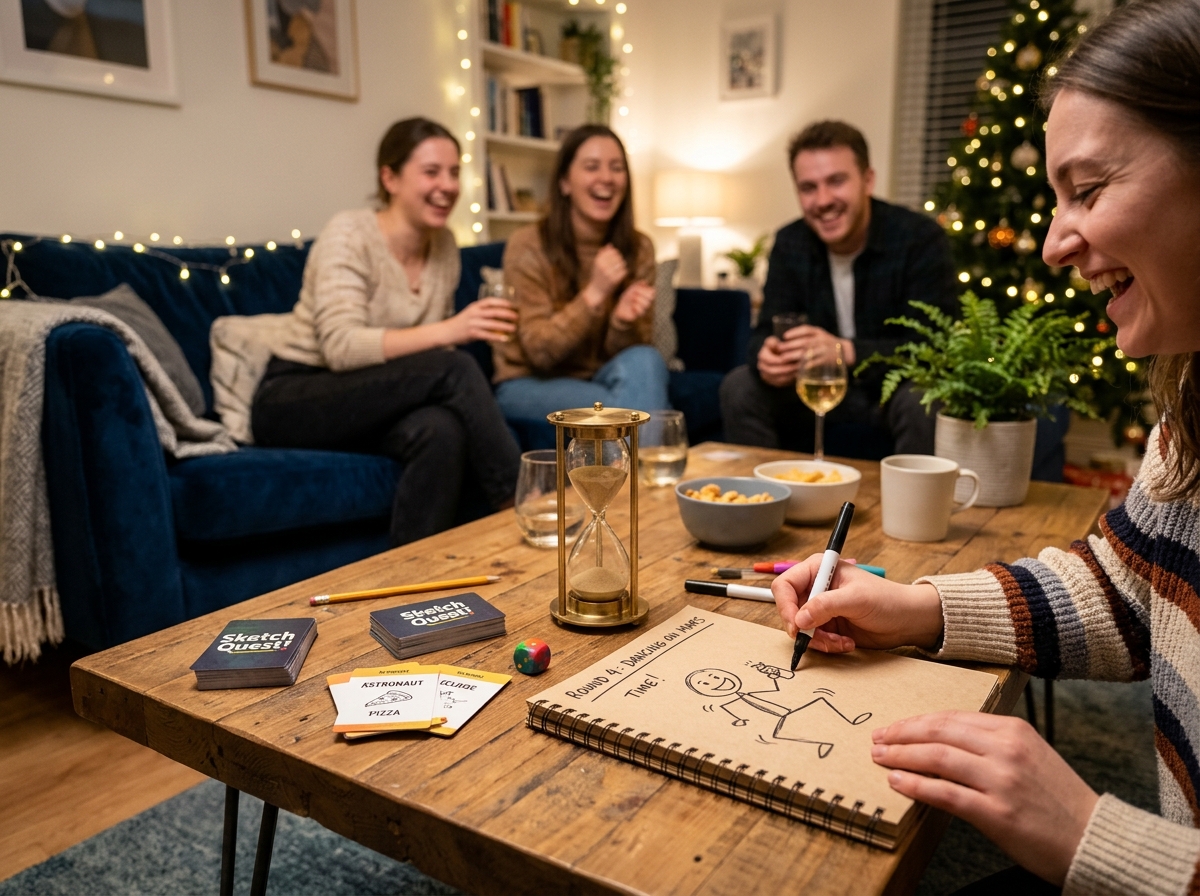
Pictionary is timeless because it levels the playing field: artistic ability is rarely as important as speed, wit, and creative shorthand. However, standard board-game card decks quickly wear out or repeat old prompts after three or four rounds.
Whether you are hosting seasoned veterans or younger siblings, picking the right prompt difficulty makes all the difference between friendly banter and total confusion.
The Anatomy of a Great Drawing Prompt
A great Pictionary word strikes a balance between tangible shapes and creative interpretation. If a word is too simple (like “Ball”), the round is over in three seconds. If it’s too obscure (like “Synecdoche”), the artist freezes.
Here are three golden rules for game night:
- Focus on action or context: Instead of just “Dog”, try “Dog digging a hole”. It gives the artist two angles of attack.
- Use visual idioms sparingly: Idioms like “Spill the beans” are hilarious but best reserved for round 3 after everyone warms up.
- Limit letters and numbers: Enforce the classic Pictionary rule: no alphabet letters, numbers, or verbal grunts allowed.
15 Crowd-Pleasing Easy Prompts
- Hot air balloon
- Campfire marshmallows
- Ferris wheel
- Ice cream truck
- Scuba diver
- Pineapple
- Pirate eye patch
- Grandfather clock
- Toothbrush with paste
- Electric guitar
- Penguin sliding on ice
- Treehouse with ladder
- Spooky spiderweb
- Popcorn bucket
- Sunglasses at the beach
20 Balanced Medium Prompts
- Astronaut eating pizza in space
- Chameleon trying to blend into wallpaper
- Tightrope walker over a canyon
- Lighthouse beam in a foggy storm
- Cat knocking a coffee mug off a desk
- Bowling a perfect strike
- Archaeologist brushing a dinosaur bone
- Chef tossing a pizza dough in the air
- Sommelier sniffing a cork
- Person running away from a swarm of bees
- Solar eclipse over mountain peaks
- Sleepwalker grabbing a midnight snack
- Roller coaster upside-down loop
- Metal detector on a deserted beach
- Submarine periscope peeking above water
- Shadow puppet of a rabbit
- Greenhouse bursting with tomato vines
- Firefighter sliding down the brass pole
- Karaoke singer hitting a high note
- Juggling flaming torches
15 Diabolical Hard Prompts
- Déjà vu
- Procrastination
- Claustrophobia
- Artificial intelligence thinking
- Bermuda Triangle mystery
- Parallel universe
- Continental drift
- Imposter syndrome
- Time travel paradoxical loop
- Schrödinger’s cat in a box
- Photosynthesis in autumn
- Daydreaming during a boring lecture
- Butterfly effect
- Subconscious memory
- Quantum entanglement
How to Keep Score Fairly
Divide your party into two teams: Team Red and Team Blue. Each round lasts 60 seconds.
- Correct guess within 30 seconds: 2 points
- Correct guess between 31 and 60 seconds: 1 point
- Passing or round timeout: 0 points (play passes to the opposing team)
Try running a “Speed Round” where teams have 120 seconds to draw and guess as many consecutive words as possible without pausing!
How to Choose the Right Prompts for Your Group
Before you print, copy, or generate a list, think about who will be playing. A group of adults who know one another well may enjoy unusual phrases and visual jokes. A family with younger children will usually have more fun when the words are familiar and easy to picture. For a mixed group, prepare a few difficulty levels and let the host move between them as the energy changes.
A useful prompt has a clear starting point. It might be an object with a recognizable outline, an action that can be shown with a stick figure, or a short scene that combines two familiar ideas. Avoid filling every card with obscure vocabulary. A challenging word should invite creative thinking, not leave the artist and guessers with no shared reference.
More Easy Prompts for a Quick Warm-Up
Use these ideas when players are learning the rules or when you want the first rounds to move quickly:
- Bicycle with a basket
- Birthday cake with candles
- Rain boots
- Sleeping cat
- School backpack
- Beach umbrella
- Snowman
- Pizza slice
- Garden hose
- Mailbox
- Teddy bear
- Traffic light
- Pop-up tent
- Pair of roller skates
- Washing machine
The easiest prompts often work because the artist can draw one large shape and add a single identifying detail. A traffic light needs three circles inside a rectangle; a mailbox needs a box and a small flag; roller skates need wheels beneath boots. Encourage players to draw big rather than spending the opening seconds on tiny decoration.
More Medium Prompts for Teams Who Know the Basics
Medium prompts are useful once everyone understands that the drawing must communicate an idea without written labels or spoken explanations:
- A baker decorating cupcakes
- A dog chasing a frisbee
- A gardener planting a tree
- A pirate searching for treasure
- A hot air balloon over a town
- A photographer taking a sunset picture
- A penguin carrying a fish
- A bus stuck in traffic
- A magician pulling a rabbit from a hat
- A camper cooking beside a tent
- A firefighter rescuing a kitten
- A musician tuning a guitar
- A robot watering flowers
- A chef flipping pancakes
- A diver exploring a shipwreck
For a phrase, break the scene into parts. Draw the person or object first, then show the action, and finally add the setting if it makes the clue more precise. The artist should not try to draw every word in the prompt separately. Choose the most memorable visual detail and build around it.
More Hard Prompts for Experienced Players
Hard rounds should test visual communication rather than obscure specialist knowledge. These prompts are challenging because they involve ideas, relationships, or events that are not represented by one simple object:
- A change of perspective
- The butterfly effect
- A missed opportunity
- A hidden talent
- A race against time
- A parallel universe
- A memory from childhood
- The calm before a storm
- A difficult decision
- A chain reaction
- A secret passage
- A balancing act
- A dream within a dream
- A disappearing act
- A moment of déjà vu
Artists can use symbols and short sequences to communicate these ideas. For example, a chain reaction might be shown as a row of falling dominoes. A race against time could use a runner beside a large hourglass. The goal is to give teammates enough clues to make a reasonable guess, not to create a perfect illustration.
Set Up Teams, Turns, and a Fair Timer
For a casual game, divide players into two or more balanced teams. Rotate the artist after each turn so that everyone gets an opportunity to draw. If the group has a wide range of ages or confidence levels, let a child draw with a partner or allow a new player to choose an easier prompt for the first round.
A 60-second timer is a convenient starting point, but it is a house rule rather than a requirement for every version of the game. You can shorten the time for simple objects or extend it for longer phrases. Keep the same limit for teams playing the same difficulty so that the result feels fair. Decide in advance whether a close synonym counts and whether a team can pass on a prompt.
A simple scoring system is often enough:
- Correct answer before the timer ends: 1 point.
- No correct answer or a pass: 0 points.
- Optional bonus: award a point for a difficult prompt only if every team uses the same rule.
Avoid changing the scoring system halfway through a match. If you want a speed round, explain the different rules before it begins. The host can keep a visible score on paper or a whiteboard so players do not have to interrupt the game to ask how many points they have.
Drawing Tips That Help Everyone Improve
Start with the largest outline and add the most distinctive feature. A bicycle is easier to recognize when its two wheels and frame are clear; a lighthouse needs a tall tower and a beam; a guitar needs a body and neck. If the first clue is not working, try a different visual approach instead of adding lots of small details to the same confusing drawing.
Use motion lines sparingly. A few curved lines can show a ball bouncing or a person running, while repeated falling lines can suggest rain. Arrows may help communicate direction if your group allows them, but avoid using letters, numbers, or written labels when playing by classic drawing-only rules. Artists should also avoid pointing to real objects in the room or acting out the answer.
Guessers can help by calling out clear possibilities rather than shouting many unrelated words at once. The artist should listen for a useful direction and add a clue that narrows the answer. Keep the atmosphere friendly: a messy drawing that leads to a correct guess is still a successful round.
Make the Next Game Night Feel Different
A prompt list can be reused in several ways. Try a category-only round with animals, food, places, or jobs. Run a family-friendly game with the easy and kids’ collections. For a more competitive group, mix action words with hard prompts and give every team the same level of difficulty.
You can explore our easy Pictionary words, Pictionary words for kids, animal Pictionary words, and hard Pictionary words for more themed ideas. If you want to create a fresh list for each round, use the word generator at the top of the site and adjust the category or difficulty before starting.
The best game night is not the one with the most complicated words. It is the one where every player gets a turn, the clues are understandable, and the group wants to play another round. Keep the prompts varied, explain the rules clearly, and let the funniest drawings become part of the evening’s stories.